My steps ringing the flagged square at Leiden. A hurried sky of quickening cloud – you know How we Dutch adore the fleeting light. A touch of brushwork. My long apprenticeship Of wooden, ungilt frames: these heavy fumes, My sweet alchemic paints. Out of this Coarse, oak-green world and harvest fields, I’ll ring the dark gold light: guilders For the Burgermeister’s daughter. I’ll tease and pry
His fingers from my Saskia’s shoulders. That sable, fur-lined cloak. I’ll shape his likeness, Claim his loss, when – please God – her fingers Will soften, with the work of man and woman. And gently stroke her rounding smock. I Remember, then, my Oma – a baker’s wife. Still girlish. Her downy cheek abrush with dust and light.
This poem was written for my brother and sister-in-law’s wedding in October 2019.
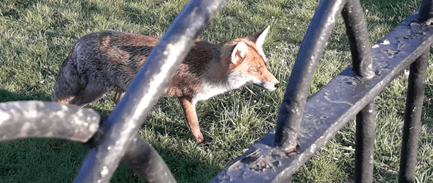
A ‘half-tame’ young vixen has taken up residence in the now-closed flower garden of my local park. Passing, I stopped to look. In broad daylight, she was being kept in food (peanuts and sausage meat) by an Italian couple, while a Japanese woman produced a half-packet of Jacob’s cream crackers from a bag folded in her hands. Watching closely, you could see the fox adapting – each quizzical tilt of the head rewarded. As I watched, though, my interest cooled at the gradual depreciating-creep as she gave up a corner of her wildness for trinkets. Even the nearby pigeons looked plump and sanguine in her presence; only a sceptical magpie kept its distance.
A ‘half-tame’ connoisseur of sausage meats
In his book, Being a Beast, Charles Foster points out that foxes and dogs belong to different genera, having “parted company about 12 million years ago.” Dogs, he says, have spent the last 50,000 years adapting to human beings. He contends, however, that foxes have the “raw mental processing power of dogs.” Foster goes on to say that adult foxes are “aggressively possessive about food.” Arguably, it is this huge appetite to survive that drives all mammals. In The Odyssey, Odysseus and his men seem to be able to endure everything except hunger. The historian Yoval Noah Harari suggests that human beings did not so much domesticate crops, as were domesticated by them, as farming lead to a shift from nomadic existence to permanent settlement. And therefore, a more traditional theory runs, to the city; to civilisation itself.
And I sometimes see a falling star…
The near-certainty of seeing something can sometimes seem to diminish its value. For two nights running last week, I searched for the Lyrid meteor shower. I followed advice to gaze into the north-eastern sky after midnight, towards the constellation Lyra. Some remaining light pollution one night; cloud-cover the next. With almost no other human company at that hour on the heath, I circled home – looking for a sign. Into that night-walk appeared six foxes. Urban foxes are common in London, but I’ve never seen so many in one dark hour. And out of this stillness, I heard new sounds. The first, a real bark – whether dog fox or vixen, I couldn’t say. (The poet Alice Oswald describes the vixen as “a woman with a man’s voice.”) The second noise, two cubs ‘play-fighting’ under a streetlight – yelping. Imagine! And, for the first time a few weeks ago, I heard the unearthly electric wail of coupling foxes in the long grass (nature’s other great hunger). I stumbled onto the plaintive scene like young Actaeon on the sight of Diana bathing. A human voyeur on a kind of vulpes interruptus.
I will have to wait until next year to see the Lyrid shower – her bright eye – the sudden brush between Hercules and Cygnus. But I’d sooner wait and be caught off-guard. Perhaps because we know we must give ourselves up – to all in life that would tame us.
Venus in the clean night air; and, strangely, something I missed at the time, top right…
All of this brought to mind a poem I’d written in the winter, Starveling. It’s posted in the POEMSsection of this site:
Charles Foster, Being a Beast (Profile Books, 2016) Yoval Noah Harari, Sapiens: A Brief History of Humankind (Harper, 2014) Alice Oswald,‘Fox’ in Falling Awake (Jonathan Cape, 2016) The sub-headings are from Auden’s elegy for Yeats, and Seamus Heaney’s poem ‘Exposure’ (more on this later…)
Life in brief: born in St Lucia in 1930. Educated on the island and in Jamaica. Walcott made his home in Trinidad and divided his time between there, where he established the Trinidad Theatre Workshop, and the United States. He taught in the US, Canada, and the UK, but did not take up a post as Professor of Poetry at Oxford, following personal controversy. He was married three times and had a son and two daughters. He died in 2017, having been awarded the Nobel Prize in 1992.
‘Days I have held, days I have lost’
“The classics can console,” the poet counsels in the final line of his 1976 poem, ‘Sea Grapes’. “But not enough.”
This is not to say the classics weren’t indispensable to him. In this poem, he calls out Odysseus, “the adulterer hearing Nausicaa’s name in every gull’s outcry.” Several decades later, Walcott’s 1992 Nobel Prize for Literature followed the publication of Omeros, his own epic version of Homer’s Odyssey.
His poetry has been described as “a territory that is at once parish and universe” (Selected Poems) – something that connected him to his friend and contemporary, Seamus Heaney. Both stored the Wordsworthian ‘seed-time’ of place and memory (like the sun’s heat in a sailor’s hands); growing outward from self to world entire. The Russian poet, Joseph Brodsky went further: “He simply has absorbed… all the stylistic idioms the north could offer… He is the man by whom the English language lives.”
Walcott’s life spanned the late-colonial period to our own shifting times, and like Heaney, he saw a world transfigured in his own lifetime. His first published work dates back to his youth aged just eighteen, in which he reflects on “this, my prone island” (‘Prelude’), referring to his birth-place of St Lucia. The same incredible body of work reaches out right into his early eighties. In his final, late flourishing, White Egrets (2010), he tells of meeting a lost love, both of them wheelchair-bound: “like a crumpled flower… her devastating smile nettled in wrinkles.” Lamenting his memory, “where a boatman left me, a half-century ago… she like a deer in her shyness.” He uses yet more classical echoes here to acknowledge that he is “stalking an impossible consummation,” as the poem’s title says – ‘Sixty Years After’. He concludes: “Now the silent knives of the intercom went through us.”
2. We are not above such things
“All art,” Walcott says, “has to do with light.” Having briefly described the brilliance of his poetry (in the full sense of the word, full of light), I am reluctant to now describe my own small imitatio. Still, here goes! …This impressionist poem grew out of a poetry workshop I held with my students. Each week I read several poems by a range of poets I loved or liked, or thought interesting. In the case of Derek Walcott, these included the short lyrics ‘Midsummer, Tobago’, and ‘Love after Love.’ (If you want to write, he advises, study the masters). Drawing on these and other poems, between workshops each Wednesday throughout the autumn term, I would sometimes experiment by writing poems after famous poets; encouraging my students to do the same. And so the poem came about.
Finally, a few things to know about Walcott: as well as a poet (playwright and theatre director), he was also a painter. He swam in the Caribbean Sea most days. In the opening section of my poem, I pick up on these ideas of the poet as painter and swimmer (that is, explorer); as well as the breadth of his career and his mastery of poetic form. Into this iconography, I then weave the tragic events unfolding in the Caribbean, as Hurricane Dorian devastated the Bahamas last autumn. In the penultimate couplet, I try to lift the poem above its specific focus, into a wider sense of suffering, and enduring hope. The collective voice of the final lines should suggest our common human experience. And as recent events have shown, we simply don’t know what may befall us. After all, we pass through, not above, our experiences, and (we hope) emerge integral; perhaps changed. In The Odyssey, Odysseus himself – the archetypal hero – often sits down and weeps as he re-lives all that has happened. But, as Walcott suggests, the poetry is the consolation.
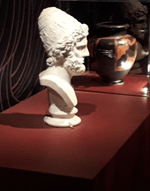
Odysseus: ‘a complicated man’ (British Museum. Troy: Myth & Reality)
The poem, Hurricane Season, was first published in The New European (#189), Thursday 2 April, 2020. It is posted in the POEMS section of this blog. I hope you enjoy the poem and find some resonance in it. Do leave a comment below, letting me know what you think of this article or the poem.
References and links to Walcott: Derek Walcott, Collected Poems: 1948—1984 (Faber & Faber: 1992); Selected Poems (Ed. Edward Baugh; Faber: 2007); White Egrets (Faber: 2010)
Derek Walcott discusses his painting and poetry (posted) 5 June 2017.
Derek Walcott reads his poem ‘Sea Grapes’ (Posted) 19 March 2019
Love after Love, by Derek Walcott, read by Tom Hiddleston (Posted) 16 July 2016


 Benedict Gilbert poems