‘I only am escaped alone to tell thee’: Bob Dylan’s Tempest

With Bob Dylan turning 80 last month, when I thought of a song to revisit, my mind went almost immediately to the title track on his penultimate album of original music, Tempest (2012). The song charts the sinking of the Titanic a century earlier in April 1912, and is based on a ballad by The Carter Family.

He captures a sense of the inevitability of the tragedy: “the promised hour was near,” he sings. It is the prophetic figure of the watchman who first intuits that something is wrong, while Leo (a painter), sees “water on the quarterdeck,/ Already three foot deep.” The force of the sinking then overwhelms the story.” With great narrative economy and elegance, we are told simply:

The engines then exploded
Propellers they failed to start
The boilers overloaded
The ship’s bow split apart.

Bob Dylan, ‘Tempest’, (Tempest, 2012)

They tried to understand:

Into this well-known story of terrible destruction, Dylan introduces a series of mainly fictional characters who seem to represent by turns heroism, innocence, self-preservation. In this way, the song presents a kind of Blakean vision of the disaster, marked by intense visual imagery.

Dylan introduces Wellington, whom he describes as valiant, the bishop (“turned his eyes up to the heavens,/ Said the poor are yours to feed”), and Jim Dandy who gives up his seat to a “little crippled child” – suggesting a sense of transcendent grace in these acts of self-sacrifice. This is reinforced by the idea of innocence: “Mothers and their daughters/ Descending down the stairs/ Jumped into the icy waters / Love and pity sent their prayers.”

Where Dylan describes acts of panic or violence, they tend to be associated not with individuals, but whole groups of people and perhaps function on a more archetypal level: “Brother rose up against brother/ In every circumstance…”; “There were traitors, there were turncoats/ Broken backs and broken necks.” There’s a clear focus on the horror of the event, but he also suggests the selflessness or desperation of loved ones clinging to each other in the freezing water.

But there is no understanding:

He also makes careful use of ambiguity. For example, the brothel-keeper, Davey, “came out dismissed his girls/ Saw the water getting deeper,/ Saw the changing of his world.” Aside from the surreal image of a brothel on board a luxury Edwardian liner, Dylan does not say what this transformation entails: on one level, it seems to be a kind of Sodom & Gomorrah-moment (worldly lust swept aside by approaching death), but into this silence could move other possibilities. Dylan also reserves comment on “the rich man, Mr Astor,” except to say that he “kissed his darling wife,” a moving image of a protective, uxorious man. Accounts record that J. J. Astor, the richest man on board, asked to remain in the lifeboat with his (much younger, pregnant) second wife, Madeleine, but was declined. According to witnesses, he was last seen smoking on the starboard bridge with another man – contemporary writer, Jacques Futrelle). Astor’s wife survived the sinking.

Others were not so lucky: “They drowned upon the staircase,/ Of brass and polished gold.”

Finally, Dylan describes three men: “Calvin, Blake and Wilson,/ Gambled in the dark,” a brilliant image which conjures their hands and the playing cards without so much as mentioning either. Again, this line has the ring of the richly symbolic about it. It also typifies Dylan’s lyrical style in this song, one characterised by chiaroscuro – the play of dark and light. For example, when Jim Dandy gives his seat to the disabled boy, we are told: “he saw the star light shining/ Streaming from the east…” which lifts the song with a sense of mysticism – perhaps suggesting the stars seen through his tears or even the bending of time itself. Dylan weaves these patterns of religious or visionary language throughout the ballad; the angels turning aside at the beginning of the song; at the end, the Captain is described:

In the dark illumination
He remembered bygone years
He read the book of Revelations
And he filled his cup with tears

‘Tempest’ – Dylan’s Blakean vision of the tragedy.

The song is more or less in twelve-eight time, with a melody both jaunty and mournful. Within this, Dylan uses a steady poetic trimetre (“The pale moon rose in its glory…”), fitting for a ballad. Interestingly, Thomas Hardy uses the same metre with three prominent stresses in his poem written just after the tragedy, ‘The Convergence of the Twain.’ Both suggest what, in retrospect, seems like the inevitability of a catastrophe that has already happened. Layered over this, the violin and accordion in ‘Tempest’ suggest both tragedy and the slightly comforting distance of the ballad’s narrative form – ‘a sad sad story.’ In this way the song could be seen as a romantic view of the tragedy, a story of horror and emptiness, or a religious parable about redemption, not to say the now-standard readings of the disaster (one of social injustice and human arrogance). What should we make of the penultimate verse, for example? “News came over the wires,/ And struck with deadly force,/ Love had lost its fires,/ All things had run their course”?

However we receive the song, Dylan seems to descend into the wreckage of the ship’s final hours in a way that resurrects the awful lived-moment of the sinking within the consoling warmth of a song altogether lit from within.

References:

Lyrics available at: Bobdylan.com/songs/tempest, © 2012 by Special Rider Music

https://en.wikipedia.org/wiki/John_Jacob_Astor_IV

I previously wrote about the songs Key West and Murder Most Foul from Bob Dylan’s most recent album, Rough & Rowdy Ways (links below).

A big thank you to the editors at Expecting Rain for re-posting my article on Key West this month (17/06/21).

https://expectingrain.com/index.shtml

https://benedictgilbert.com/2020/05/08/the-blood-stained-banner-bob-dylan-review-murder-most-foul/

The Carter Family, ‘The Titanic’

Featured image: Pexel free photos.

Content: © Benedict Gilbert 2021
Give me your arm, Old Toad! Larkin Revisited

I. What else can I answer? “Both conversational and lyrical,” the biographer Claire Tomalin has said. And elsewhere: “he wrote in a tradition that valued formal structure, but his voice is entirely his own.”

She was writing not about Philip Larkin (1922–1985), but Thomas Hardy, whose poetry was the greatest influence on Larkin’s mature work. All these things could be said of Larkin himself, though, despite the differences between the two poets. In fact, it was arguably Hardy who enabled Larkin to write most like himself by allowing him to write directly about his own experiences and to do so in a vernacular key. Consider this from near the end of ‘Toads Revisited’ (a poem about how we need work for the shape, meaning and distraction it provides us in our lives). The tone is honest, rueful, knowing; the symbolism naturalistic, with a dash of quirky surrealism:

“What else can I answer,

When the lights come on at four,
At the end of another year?
Give me your arm, old toad;
Help me down Cemetery Road.

‘Toads Revisited’, The Whitsun Weddings (1964)

Larkin was a complex man often over-simplified – not least by the public persona he helped to encourage. A kind of strategy to retain his privacy and most likely guard the sources of his writing – a fragile, irregular thing. He was a prolific author of letters and diaries, yet his poetic output was slight (four slim volumes in as many decades). Accused of misanthropy and misogyny, but capable of great affection and tenderness; death-obsessed, melancholy, an occasional bon viveur. Very funny, but often unkind in his private comments. A lover of jazz (pre-Charlie Parker). A progressively heavy drinker. Larkin was quietly rebellious, somewhat reclusive; an outsider, a reactionary anti-modernist. A poet shy of publicity but unafraid of controversy.

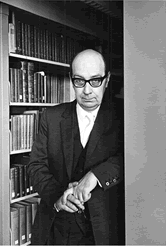
Philip Larkin at the Brynmor Jones Library, University of Hull, 1969

II. A Writer’s Life: In his superb biography, Philip Larkin: A Writer’s Life, Andrew Motion charts his development as a sometime novelist, and young poet (influenced by Yeats and Auden) – to the growth of his mature style. The two men were friends towards the end of Larkin’s life.

Motion points out that rather than turn his back on the lyrical, symbolist influence of W. B. Yeats, he instead learned to control this impulse, which breaks out at key moments, creating instances of ‘lift off’, often at the end of poems (Our Life in Poetry). He points to notable examples, such as the end of ‘The Whitsun Weddings’, with the newly married couples released, “like an arrow shower […] somewhere becoming rain.” And also to ‘High Windows’, a poem fuelled by sexual jealousy of the young, which ends with “the thought of high windows/… the deep blue air, that shows/ Nothing, and is nowhere, and is endless.” Commentators variously dispute whether these windows represent the Brynmor Jones Library where he worked in Hull, a tower-block, a hospital, or the stained-glass windows of a church (“the sun-comprehending glass”). And further, what the emptiness beyond might signify (something to fear or celebrate?) Since Larkin rarely discussed the meaning of his work or gave public readings, this remains pleasingly unresolved.

Motion also considers what fired Larkin’s writing, arguing that his work is as much about life and relationships as it is about death. Despite several close friendships with men (most notably the writer Kingsley Amis at Oxford in the 1940s), all Larkin’s most important relationships, he points out, were with women: his mother, Eva, and the principal women with whom he conducted simultaneous affairs – Monica Jones and Maeve Brennan. These relationships can be traced through his writing. What is interesting, though, is that despite the vernacular language and clear references to lived experience, the direct origins of these experiences remain deliberately vague.

Being interviewed by John Betjeman, Monitor (BBC, 1964); the rabbit at Larkin’s elbow a likely private reference to Monica Jones.

III. Veiled Autobiography: Larkin wrote a number of poems about the women with whom he was intimately involved. In ‘Wild Oats’, written about his first girlfriend, Ruth Bowman, he describes “a ten guinea ring/ I got back in the end,” and concludes dryly, that he was “too selfish, withdrawn,/ And easily bored to love./ Well, useful to get that learnt.” The final line here suggests a veneer of self-protecting irony. He wrote ‘Broadcast’ for Maeve Brennan (“Your hands, tiny in all that air, applauding”). ‘Talking in Bed’ is about Monica Jones, in which he struggles to find words “not untrue and not unkind” – although he also wrote plenty of very kind words to her in their private letters (addressing her as Dear Bun, or Dearest Rabbit).

For Eva Larkin (whom he affectionately called Mops, or his ‘old creature’), he wrote poems such as ‘Love Songs in Age’ (about her sheet music), in which he describes how “she kept her songs, they took so little space.” He employs the same traditional iambic pentameter for the poem ‘Maiden Name’, with the beautifully lyrical, “Its five light sounds no longer mean your face” (written for Winifred Arnott of whom he was especially fond in his 20s). These poems reveal, as Sean O’Brien says, “a remarkable sympathy for women’s lives” (The Firebox, p. 83), which challenges the view of Larkin as simply misogynistic. Nevertheless, he could behave shabbily when it came to his intimate relationships, especially regarding Maeve Brennan, with whom he conducted a seventeen-year affair only to finally leave her for Monica Jones. Motion observes that by sustaining two relationships simultaneously, he kept himself free of commitment to either woman. He suggests, rather brilliantly, that if Larkin was slightly too happy or unhappy, he couldn’t produce poems: “rarely did his life attain the right emotional temperature for writing,” he says (p.278).

There was obviously a reason Larkin kept the origins of his poems obscure (as poets often do), and although this kind of biographical trowel-work is interesting, there must be more to the poems than uncovering personal revelation, or why would we still read them so closely? It was clear that Larkin both wanted and needed a carefully guarded private life in order to write. Poetry that was both a slim and a rich harvest. Tellingly, in ‘Forget What Did’, he writes (of the things recorded in his diary) that when he stopped writing, he:

wanted them over,
Hurried to burial,
And looked back on

Then the poem flashes brilliantly:

Like the wars and winters
Missing behind the windows
Of an opaque childhood

‘Forget What Did’, High Windows (1974)

Again, windows signal something unknowable. Interestingly, it was these diaries that Monica Jones destroyed after his death, at Larkin’s request.

Looked back on, what stands out about Larkin’s mature poetry is the versatility of his writing, from the discursive thread of private thought (as in one of my favourite poems, ‘Dockery & Son’), to the near-visionary (like ‘Livings II’ – although these moments seem always transitory in Larkin, fleeting); to a close, if personal documentation of post-war Britain into the 1970s. Despite his preoccupation with death and emotional failure, he can display a surprising range, with “remarkable combinations of scale and detail” (O’Brien, p. 83), spanning his modest oeuvre. As in ‘The Whitsun Weddings’, he was the great observer, “on the edge of things” (Monitor). He combined an almost cinematic sweep with extreme close ups of familiar, often difficult feelings which he unfolds to the reader in a nuanced, if irresolute way. Larkin’s view of life may be bleak, but his poetry provides a certain consolation through recognition of our common failures. His voice remains inimitable and instantly recognisable. He was a kind of secular suburban Psalmist of the mid-Twentieth Century. And as T. S. Eliot said of him: “He makes words do what he wants.”

© Benedict Gilbert 2021

References in this post:

Featured image: Philip Larkin by Fay Godwin, 1969. © The British Library Board (Wikipedia: Assumed Fair Use)

Claire Tomalin, Thomas Hardy: the Time-Torn Man (Penguin, 2007); xviii
Poems of Thomas Hardy (Selected and Introduced by Claire Tomalin), (Penguin, 2007), xiv—xv
Andrew Motion, Philip Larkin: A Writer’s Life (Faber, 1993; 2018)
Philip Larkin, Collected Poems, (Anthony Thwaite, Ed.), (Faber, 1998)
Our Life in Poetry: Motion on Larkin (Youtube)
Sean O’Brien, The Firebox: Poetry in Britain & Ireland after 1945 (Picador, 1998)
Anthony Thwaite (Ed.) Philip Larkin: Letters to Monica (Faber, 2010)

Of the documentaries about Larkin, the Monitor/BBC, Down Cemetery Road (1964), was made during his lifetime, as was The Southbank Show (1982). Of the more recent documentaries, Love & Death in Hull (2003) is an interesting if slightly generalised look at his life and work, although it does have some very valuable interviews, for example with Maeve Brennan. A. N. Wilson’s Return to Larkinland (2015) is a compassionate look at Larkin’s legacy, by another old friend. The most comprehensive is Philip Larkin: Bookmark (1993). Philip Larkin reading his poems is available in The Sunday Sessions (recorded in 1980; released by Faber in 2012). Martin Amis’s Philip Larkin, Selected Poems (Faber, 2011), is a good place to start with his work.